
SIGNUM MAGNUM • Mustjala festival 2026
FINAL CONCERT
SIGNUM MAGNUM
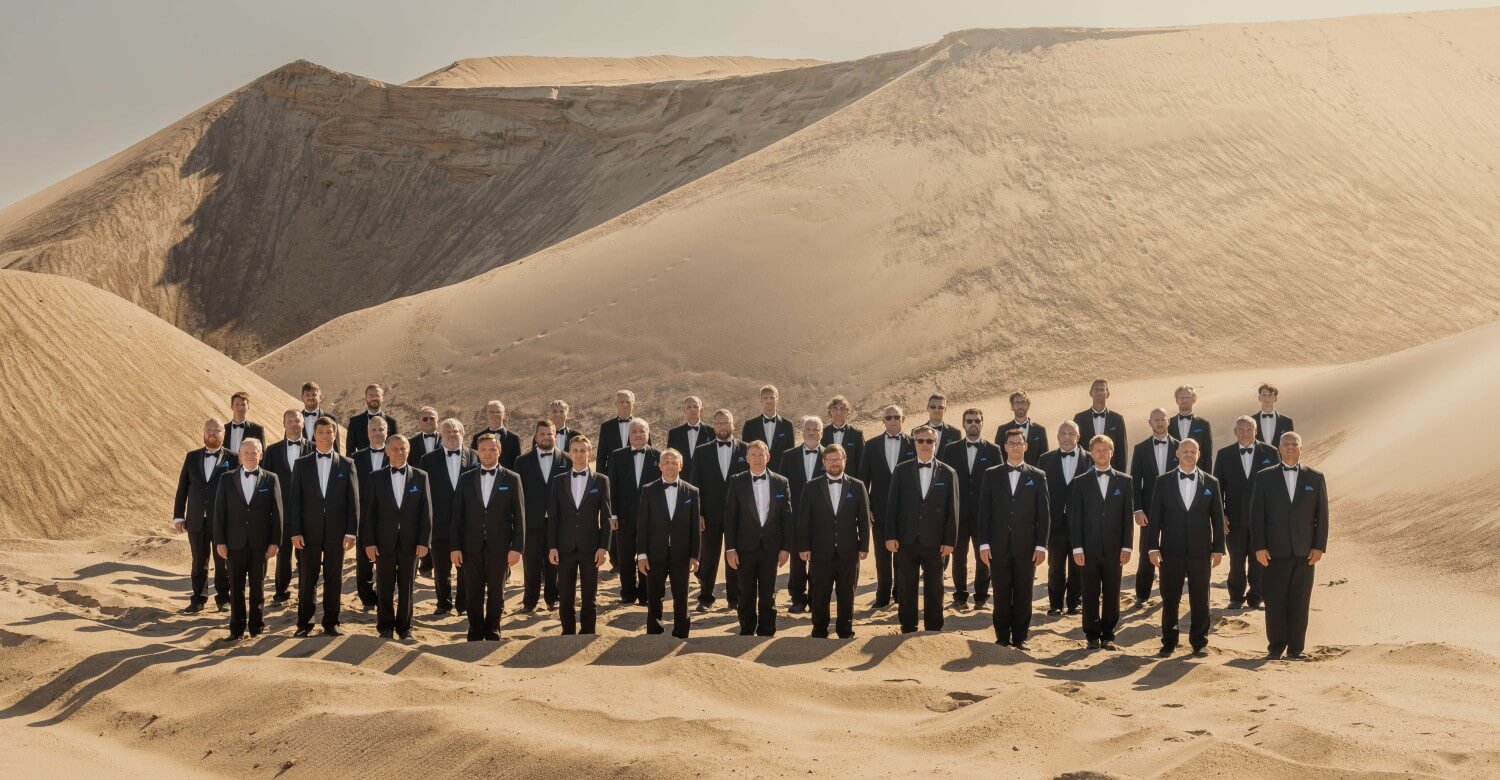
Estonian National Male Choir
Conductor Mikk Üleoja
Aare Tammesalu - cello
Program:
Gregorian Chant Litaniae Lauretanae
Giovanni Gabrieli - Exaudi Deus
Felix Mendelssohn Bartholdy - Vespergesang op 121
Arvo Pärt - And one of the Pharisees...
Giovanni Gabrieli - Litaniae Beatae Mariae Virginis
Arvo Pärt - The Deer's Cry
Giovanni Bonato - Signum magnum
Arvo Pärt - Da pacem Domine
Koostöös Eesti Rahvusmeeskooriga.
Honoured with the Grammy Award (2004), the Estonian National Male Choir (ENMC) has made its way to one of the most unique musical collectives in the world.
Over the course of eight decades, the choir has shaped Estonia’s international reputation as a country with a deep choral heritage and has been a leading advocate for the music of Estonian composers, most notably Veljo Tormis. The choir has given more than 7,000 concerts, ranging from Estonia to North America and Asia, and has performed under renowned conductors such as Paul Hillier, Eric Ericson, Kaspars Putniņš, Teodor Currentzis, and Kent Nagano, among others.
Currently comprising 46 professional singers under the artistic direction of Mikk Üleoja, the ENMC has undergone a striking artistic transformation, reaching its current position as an appealing stage partner to some of the world’s most distinguished orchestras and festivals. In 2015, the Estonian National Male Choir and Mikk Üleoja were honoured with the National Cultural Award in recognition of their outstanding musical contributions.
Recording constitutes a vital strand of the Choir’s artistic activity: releases on prestigious labels including Toccata Classics, Deutsche Grammophon, Sony, Ondine, and Aurora have attracted widespread international acclaim.
The Estonian National Male Choir is also a committed commissioner of new works and an initiator of innovative collaborations. Presenting numerous new programmes each season, the ENMC’s repertoire ranges from the Renaissance to the present day.
Today, the Estonian National Male Choir balances a profound respect for its history and heritage with a confident, forward-looking outlook. Its mission is to sustain and advance the tradition of male choral singing as a vital and expressive art form, offering audiences musical experiences of exceptional quality and enduring resonance.
Mikk Üleoja graduated from the Estonian Academy of Music in 1997 from Professor Ants Üleoja’s conducting class and received a master’s degree in music there in 2004, under the supervision of Professor Toomas Siitan.
He sang in the World Youth Choir (1989–1992), the Estonian National Male Choir (1994–1996), the Estonian Philharmonic Chamber Choir (1996–2000), and the Gregorian chant ensemble Vox Clamantis (1998–2011).
Mikk Üleoja has served as conductor of the St Michael’s Boys’ Choir, chief conductor of the chamber choir Mattone and the concert choir of Kaarli Congregation, and taught conducting at the Viljandi Culture Academy. From 1998 to 2011, he was choirmaster of the Estonian Philharmonic Chamber Choir. Since the 2011/2012 season, Mikk Üleoja has been the artistic director and chief conductor of the Estonian National Male Choir.
Eight albums have been released under Mikk Üleoja’s direction, five of which — Galina Grigorjeva’s author albums In paradisum (2014) and Galina Grigorjeva muusikat meeskoorile (2023), Henrik Ødegaard’s author album Te lucis ante terminum (2016), REGIRAM (2019), and Baltic Contrasts (2023) — were recorded with the Estonian National Male Choir. The album Luule, see ei tule tuulest (2007), recorded with the Estonian Philharmonic Chamber Choir, received the Estonian Cultural Endowment’s 2007 annual prize, and the recording was named the best choral album of the year. Galina Grigorjeva’s author album In paradisum won the title of Classical Album of the Year at the 2015 Estonian Music Awards.
- 2014: Annual Prize of the Estonian Choral Association — Conductor of the Year.
- 2015: National Cultural Award together with the Estonian National Male Choir for outstanding works that reached the public
- 2024: Order of the White Star, 4th Class.
Cellist Aare Tammesalu works as a soloist and chamber musician, performing both classical repertoire and contemporary music. In addition, he is an active concert organizer. Tammesalu studied the cello at Tallinn Music High School in Laine Leichter’s class and at the Tallinn State Conservatory with Ivo Juul and Professor Toomas Velmet. He is a laureate of the Republican String Players’ Competition (1987) and winner of a special prize for the best performance of a work by J. S. Bach. He later continued his studies in the master’s programme at the Estonian Academy of Music and Theatre under Professor Peeter Paemurru.
He has refined his instrumental skills in private lessons in Moscow with Professor Mikhail Khomitser and has taken part in master classes with Professor Martin Ostertag. Tammesalu has performed at nearly all major Estonian music festivals and at internationally renowned festivals in Europe, North and South America, Japan, Russia, and Iran. He has appeared as a soloist with the Estonian National Symphony Orchestra, the RO Estonia Symphony Orchestra, Klaaspärlimäng Sinfonietta, Pärnu City Orchestra, the 21st Century Orchestra, the Kotka City Orchestra in Finland, the chamber orchestra ME, the Estonian National Male Choir, and the mixed choir of the Moscow Conservatory in Russia. He has also participated in the work of several musical ensembles, including Reval Ensemble, the Tobias String Quartet, and Resonabilis. He has premiered works by many composers.
In 2008, Aare Tammesalu created the musical concept for the restoration of the silent film Young Eagles (1927, directed by T. Luts), and he took part in the restoration of the soundtrack and the re-recording of the music for the ETV feature film Dark Windows (music by E. Tamberg). Tammesalu has worked as a music producer for Eesti Kontsert and Pärnu Philharmonic. Since 1995, he has been the artistic director of the Mustjala Festival in Saaremaa and of the Kadriorg Palace Music concert series.
Aare Tammesalu’s work has been recognised with the annual prize of the Estonian Cultural Endowment and the Estonian Music Council, a special prize from the jury of the Estonian Theatre Union, and the Hendrik Krumm Cultural Prize. In February 2023, Saaremaa Municipality honoured Aare Tammesalu with the award “Achievement of the Year 2022” for organising the Mustjala Festival; in 2023, the Council of the Estonian Evangelical Lutheran Church named him “Friend of the Church of the Year.” In January 2025, he received the annual prize of the Saaremaa expert group of the Cultural Endowment for organising an Eestonian National Symphony Orchestra concert in Mustjala in June 2024. Aare Tammesalu is an honorary citizen of Mustjala Parish and a recipient of its order of merit.
Giovanni Gabrieli (1553–1612) studied under his uncle Andrea Gabrieli and Orlandus Lassus. Following his uncle’s death, he was appointed in 1585 as organist and musical director of St Mark’s Basilica in Venice, a position he held for nearly three decades. In addition to its remarkable beauty, St Mark’s was renowned for its unique architecture: two organs were positioned opposite each other in the choir lofts. Performances could involve two to five choirs, arranged facing one another on galleries, as well as on either side of the altar and even in the centre of the church.
This spatial arrangement gave rise to the distinctly Venetian practice of dispersed choirs, known as cori spezzati, which enabled the creation of striking polychoral music. Both notated echo effects and the church’s natural acoustics played a significant role, the latter being skilfully exploited by composers. It is likely that the prominence of echo also contributed to Gabrieli becoming the first composer to employ dynamic markings such as piano and forte, as the contrast between different choirs and instruments, alternating softly and loudly, produced a highly effective result.
Gabrieli’s oeuvre is extensive, encompassing both instrumental and vocal works published in various collections. Among the most important are the two volumes of Sacrae symphoniae, issued in 1597 and 1615. The first contains 63 works, including 45 motets, while the second comprises 32 polychoral compositions. For the Estonian National Male Choir, Aare Kruusimäe has arranged four motets from the first collection and one from the second. Although the number of vocal parts has been reduced to suit the male choir setting, the overall sonic character remains unaffected.
Felix Mendelssohn Bartholdy (1809–1847), one of the leading figures of the Romantic era, owed his remarkably diverse catalogue of works to an exceptional musical upbringing and practical training. Thanks to a private orchestra maintained by his father, he was able from an early age to develop his skills as a conductor and to test the sonorities of his compositions. Music-making at family concerts with his siblings provided valuable chamber music experience, while his participation as a choirboy at the Berlin Singakademie fostered a lifelong affinity with vocal music.
In concert practice today, Mendelssohn is best known for his orchestral and chamber works; yet of his 120 opus numbers, more than half belong to the realm of vocal music. The pinnacle of this output is undoubtedly represented by his two grand biblical oratorios. The Vespergesang (“Vesper Song”) for male choir and cello, Op. posth. 121, was composed for liturgical use in the Catholic Church, although the exact circumstances of its composition remain unknown. The work was completed on 5 February 1833 and performed the following year in Berlin, but it was not published until 1873, after the composer’s death, as his final opus, No. 121.
Mendelssohn’s religious outlook was shaped by his Jewish heritage, his Protestant upbringing, and his encounters with the Catholic Church. Vespergesang offers a vivid example of his religious pluralism: Gregorian chant of Catholic origin coexists here with the Lutheran chorale, while the use of contrapuntal techniques and Baroque-style basso continuo pays homage to his great idol, Johann Sebastian Bach.
Male-voice choral works run like a red thread throughout Mendelssohn’s творчество, amounting to a total of 38 compositions, only a small portion of which were published during his lifetime. These works were written primarily as commissions or as gifts for various choral societies, intended for performance both by vocal ensembles and full choirs.
Arvo Pärt is one of those composers in the world, whose creative output has significantly changed the way we understand the nature of music. In 1976, he created a unique musical language called tintinnabuli, that has reached a vast audience of various listeners and that has defined his work right up to today. There is no compositional school that follows Pärt, nor does he teach, nevertheless, a large part of the contemporary music has been influenced by his tintinnabuli compositions.
He was born on 11 September 1935 in Paide, Estonia. After studies in Heino Eller’s composition class at the Tallinn State Conservatory, he worked as a sound engineer for Estonian Radio. Since the late 1960s, Pärt has been a freelance composer.
Both the avant-garde spirit of Pärt’s early works as well as the religious aspect of the music he composed in 1970s led to controversial reviews and confrontations with Soviet officials. In 1980, Arvo Pärt and his family were forced to emigrate – first to Vienna and then to Berlin, where they stayed for almost 30 years.
The year 1984 marks the beginning of his creative collaboration with the distinguished CD label ECM Records and the producer Manfred Eicher, and the first recording of Tabula rasa. Since then his music has been performed and recorded by the best orchestras and interpreters of our time.
In 2010, Pärt returned to Estonia where he resides today.
Arvo Pärt gained recognition already in 1960s, when he became one of the leading figures of the so-called Soviet avant-garde. Several significant modernist composition techniques entered in Estonian music scene namely with Pärt’s works – Nekrolog, Perpetuum mobile, Pro et contra, among others.
His dramatic collage piece Credo (1968) turned out to be a turning point in his ouvre as well as his life – Pärt withdrew and renounced the techniques and means of expression used so far. Pärt’s quest for his own musical voice drove him into a creative crisis that dragged on for eight years. During these years he joined the Orthodox Church and studied Gregorian chant, the Notre Dame School and classic vocal polyphony.
In 1976, Pärt emerged with a new and highly original musical language which he called tintinnabuli (tintinnabulum – Latin for ’little bell’). The first tintinnabuli-piece, Für Alina, for piano (1976) was soon followed by works like Cantus in Memory of Benjamin Britten (1977), Fratres (1977), Tabula rasa (1977), Spiegel im Spiegel (1978) and many others.
Pärt’s oeuvre is rich and versatile, including many large-scale compositions for choir and orchestra, four symphonies and works for soloists and orchestra, as well as numerous choral pieces and chamber music. The majority of his works are based on liturgical texts and prayers, like Passio (1982),
Te Deum (1985), Miserere (1989/92), Kanon pokajanen (1997), and Adam’s Lament (2010), to name a few.
And One of the Pharisees... for three voices (countertenor or alto, tenor and bass) or a three-voice choir a cappella was composed in 1992 and dedicated to Paul Hillier. The piece was premiered in February of the same year in Davis, California by the ensemble Theatre of Voices.
Pärt has designed the parables from Luke 7 into a musical scene featuring male voices due to the characters in the story. The countertenor (or alto) and the bass voice appear as solo parts that convey a dialogue between Simon the Pharisee and Jesus, while the narrative passages of the events are homorhythmically sung by all voices. The music is rather ascetic, subjecting everything to the narrative, the word. The scope and dynamics of the melody is in correlation with the number of syllables in the text and the melodic formation is premised on the rules of tintinnabuli. Due to the large number of one-syllable words in the English translation, the melody remains mostly static, giving a recitative-like atmosphere to the work. As an exception, the melodic line of Jesus (the bass part) is not tied to the rules of tintinnabuli and is composed more freely using stepwise motion.
The choral piece The Deer’s Cry was composed in 2007 on commission from the Louth Contemporary Music Society. Pärt built his piece on a passage from a 5th century text allegedly written by Saint Patrick. Saint Patrick, the patron saint of Ireland, was the one who brought Christianity to Ireland, and is acknowledged as a saint by all Christian Churches. Historians and theologians have called him the Apostle of Ireland for his long and exceptionally intense missionary work.
There is a legend about The Deer’s Cry, the holy lorica* or the breastplate prayer, telling the story of Saint Patrick who, knowing that he and his accompanying monks were being ambushed and likely killed, led his men through the woods reciting that prayer. The enemies saw them in the woods as a mother deer with calves, and Saint Patrick and his men were thus saved.
Just as in several of his choral pieces from the first decade of the 21st century, here too Pärt has distanced himself from strict tintinnabuli technique, instead highlighting the presence of tonality as an inherent feature of Pärt’s compositional system. The harmony of The Deer’s Cry is deeply rooted in A minor, which also emphasises the steadfast nature of the prayer text.
The Deer's Cry premiered on 13 and 14 February 2008 in St. Peter’s Church in Drogheda and St. Patrick’s Cathedral in Dundalk, performed by the State Choir Latvija conducted by Fergus Sheil. The piece is dedicated to Eric Marinitsch from Universal Edition, with whom the composer has been in creative collaboration since the early 1990s.
Arvo Pärt received the original impetus for composing his Latin vocal piece, Da pacem Domine (Latin for “Give us peace, Lord”), from Jordi Savall, a virtuoso gambist and researcher of early music, who commissioned it for his peace concert. Savall had the idea to put together a concert programme under a common theme based on Da pacem Domine, a 9th century Gregorian antiphon, and music from different centuries based either on its text or its melody.
Therefore, Arvo Pärt has built his work on the melody of the antiphon (which can be heard in the alto part) and added three polyphonic voices composed using the tintinnabuli technique. This is an exceptional case in Pärt’s music because he usually does not quote Gregorian chant in his works. However, Pärt has composed this piece like a motet in the spirit of Renaissance music, using the traditional cantus firmus* method and structuring the form with cadenzas typical of Renaissance music. Another association with the performance practices of early music is the fact that Pärt simply composed Da pacem Domine as four-part music and did not designate the exact set of performers. At the same time, the unfixed set of timbres is also characteristic of several of his other works (Pari intervallo, Fratres etc.) and was especially relevant in his early tintinnabuli works of the 1970s. So far, there are nine different versions of the music for Da pacem Domine for various instrumental settings: for cellos, saxophones, recorders, voices and orchestra among others.
Da pacem Domine premiered in July, 2004 in Barcelona, performed by the early music ensemble Hespèrion XXI, La Capella Reial de Catalunya and Jordi Savall. The entire concert was dedicated to the memory of the victims of the bomb attack in Madrid in March of the same year. This piece by Pärt is sometimes considered a direct dedication to the victims of the terror attack in Madrid, as the piece was indeed finished a few days after this act of terror. However, Da pacem Domine is in fact a universal prayer for peace about the pain and suffering of all of humankind, expressing a firm belief that God is our only true protection, especially during restless times.
Born in Schio in 1961, Giovanni Bonato began his studies in composition in Vicenza with Fabio Vacchi and continued at the Giuseppe Verdi Conservatory in Milan under the guidance of Adriano Guarnieri and Giacomo Manzoni. He also studied orchestral conducting at the Scuola Civica di Musica di Milano. He is currently a professor of composition at the Cesare Pollini Conservatory in Padua.
Bonato’s creative output is both extensive and diverse, encompassing chamber, choral, and orchestral works. His list of competition successes and awards is impressive, and his compositions have been performed by distinguished artists at major music festivals. Despite the centuries that separate them, both Gabrieli and Bonato share a profound interest in sonority; however, unlike Gabrieli, Bonato does not compose with a single specific space in mind. His vocal works are primarily conceived for coro spazializzato, or spatial choir, in which the singers are distributed throughout the performance space according to precise instructions indicated in the score.
Bonato’s works are often marked by a certain static quality: movement is gradual and stepwise, extended melodies are largely absent, and are frequently replaced by declamation. The richness of the musical texture arises instead from spatiality, an element that is always integral to the composition. As the composer himself has noted, the drama in his works is expressed not merely through harmony, dynamics, or phonetics, but above all through the spatial activity of the musical texture; his aim is to envelop the listener in a sonic dimension imbued with pathos and emotional intensity.
The Estonian National Male Choir has maintained a collaboration with Bonato for approximately two decades. The composer first discovered the choir through its website and sent them the score of his work Crux fidelis (2001). After hearing the choir’s recording of the piece, Bonato composed Signum magnum for male choir and cello in 2005 as a commission from the ensemble. The choir subsequently added further works by Bonato to its repertoire, and the idea emerged to record an album juxtaposing the mutually enriching and balancing works of Gabrieli and Bonato. These pieces were recorded in 2014 under the direction of Mikk Üleoja; regrettably, the recording proved to be the final work of one of Estonia’s most esteemed sound engineers, Maido Maadik.
Signum magnum (“A Great Sign”) for cello and spatial male choir was commissioned by the Estonian National Male Choir and premiered in 2006 under the direction of Ants Soots, with Aare Tammesalu as the soloist. The Latin text is drawn from the Book of Revelation and Psalm 44, while the English text derives from William Blake’s poem Auguries of Innocence. The cello assumes a leading role, opening with long, dark tones. The choir gradually merges into this texture, creating a sense of spatial depth while remaining a backdrop to the cello. The cello part is highly varied, ranging from agitated low tremolos to piercing harmonics, from light pizzicati to lyrical melodic lines. High tones reminiscent of the overtones produced by glass vessels further intensify the otherworldly and mystical atmosphere that pervades the work.
The organizers of the Mustjala Festival are MTÜ Loovüksus and the Mustjala District.
The artistic director is Aare Tammesalu.
Eesti Kultuurkapital, Saaremaa vald, fond Vöimalus, Liszti Instituut - Ungari Kultuuri Keskus Tallinn, Mustjala käsitöösahver, Mustjala rahvamaja, Mustjala kool, Nasva rahvamaja, Kihelkonna kirikumuusika päevad, Škoda (Warma Auto, Kuressaare), Mr. and Mrs. Naagel, Mr. and Mrs. Schmidt
Event timeline/line-up